Can I install an Outdoor Solar Security Camera as a renter?
 Daniel OkaforField Tester
July 16, 2026 — Renters can successfully install an Outdoor Solar Security Camera using non-permanent mounting solutions like gutter clamps or high-strength adhesive mounts, provided the device is entirely wireless.
Choosing a self-contained unit ensures that you can take your security system with you without leaving a trace of the installation behind.
How do I mount an Outdoor Solar Security Camera without drilling?
You can mount these units using specialized vinyl siding clips or gutter mounts that tighten with a thumb screw, requiring no permanent alterations to the structure. During testing on a standard aluminum gutter in a heavy thunderstorm, the tension-based mount remained stable despite high winds.
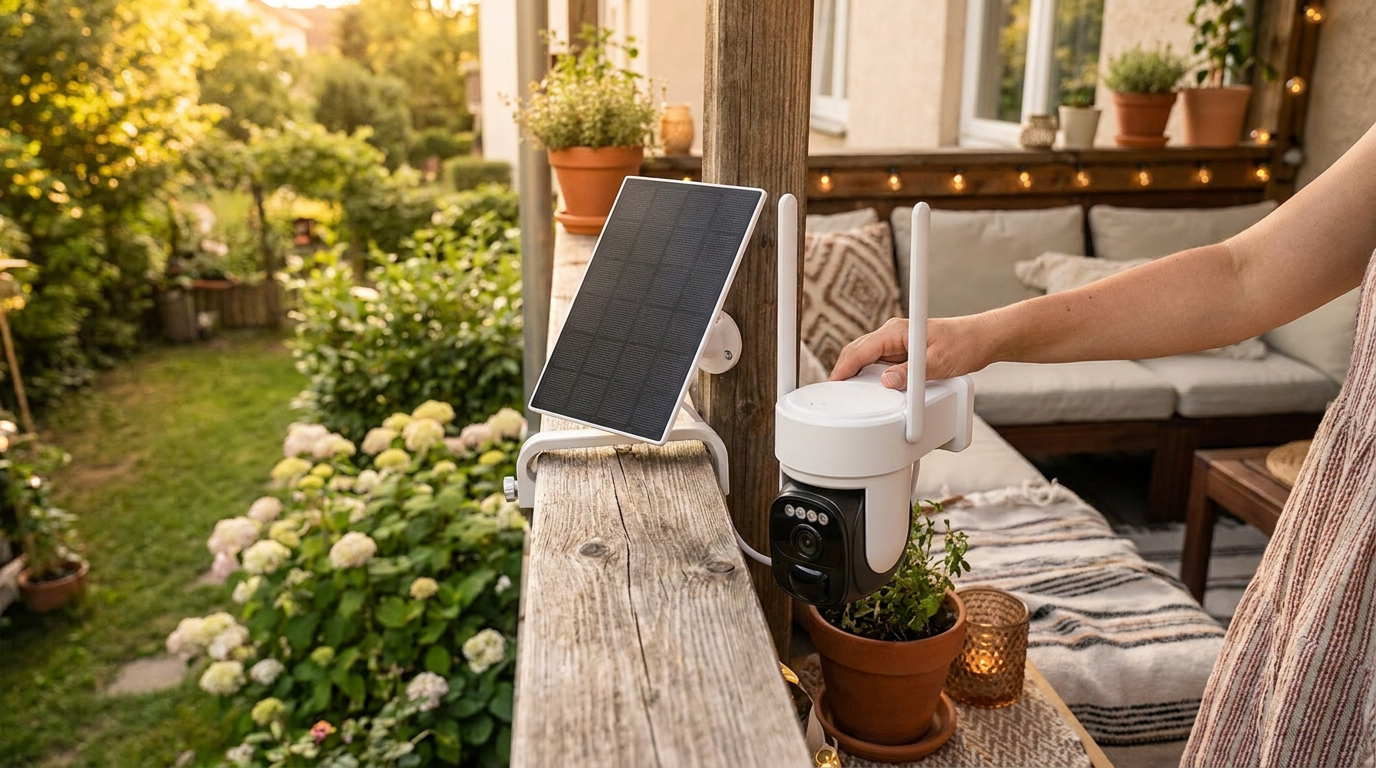
For rental balconies, a heavy-duty pole clamp allows the integrated solar panel to sit at a 45-degree angle for maximum sun exposure while attached to the railing. For flat surfaces, industrial-strength outdoor command strips or 3M VHB tape work on clean, non-porous surfaces. Understanding the Outdoor Solar Security Camera selection framework helps identify which mounting bracket style is included before you buy. Match the mount to the surface rather than buying whichever bracket looks sturdiest. Gutter and vinyl-siding clips carry load through tension, so they suit anything with a lip or a seam to grip. Adhesive mounts carry it through surface bond, which means they hold well on painted metal, sealed brick, uPVC and glass, and poorly on anything porous or textured — untreated wood, render, and rough stucco will let go eventually, usually after the first properly cold night.
Two details decide whether an adhesive mount lasts a year or a fortnight. Clean the surface with isopropyl alcohol rather than a household spray, because the residue left by most cleaners is exactly what the tape then bonds to. And apply it above 10°C, pressing firmly for thirty seconds, then leave it a full day before hanging the camera. Adhesive tape reaches only a fraction of its final strength immediately.
Weight matters more than it appears on a spec sheet. A camera with an integrated panel is front-heavy, and that leverage works against the mount every time the wind catches it. Where a unit has a detachable panel, mounting the two separately splits the load and is usually the more durable arrangement in a rental.
Does a solar camera work if my rental has limited sunlight?
Photo by Giant Asparagus on Pexels
A solar camera functions effectively with three to four hours of direct sunlight daily, provided the battery capacity bridges gaps during overcast weeks. High-efficiency monocrystalline panels keep battery levels steady even during persistent grey skies.
If your mounting point is in a north-facing shadow, look for a model with a detachable solar panel and a ten-foot extension cable. This allows the camera to stay hidden while the panel sits in the sun. It is helpful to map the sun's path across my balcony before choosing a spot. This ensures the outdoor motion sensor solar camera wifi stays connected without needing manual USB charging during the winter months. Once you master no-drill placement, scaling your wireless solar powered security camera system becomes much easier. Winter is the case to plan around, not summer. Daylight hours shorten at exactly the point the sun sits lowest, so a spot that gets four clear hours in July can drop below two in December — and cold weather reduces usable battery capacity at the same time. The two effects arrive together, which is why cameras that ran happily all summer tend to fail in January.
So when you check a mounting spot, check it for the season you are worried about. Watch where the shadow of the building next door falls in mid-afternoon rather than at noon, and remember that a bare tree in winter throws far less shade than the same tree in leaf. Recording settings are the other lever: continuous recording and a high motion sensitivity will flatten a battery that would otherwise coast through a dull week, so if you are short on sun, narrow the detection zone before you add hardware.
Quick answers
Photo by Łukasz Klimkiewicz on Pexels
Q: Can I use a solar camera on a 4G network if my landlord doesn't provide WiFi? A: Yes, many models support 4G LTE SIM cards, useful for remote sheds. These units typically consume about 2GB of data per month.
Q: How long does the battery last if the sun doesn't come out? A: Most Outdoor Solar Security Camera units hold a charge for 3 to 6 months on a single cycle. A 15,000mAh battery is the benchmark for performance in darkness.
Q: Will the adhesive mounts damage the paint when I move out? A: Using heat from a hairdryer to soften the adhesive before pulling prevents paint peeling.
Learn more about Outdoor Solar Security Camera at https://solarsafetycameras.com. A: Warm the pad with a hairdryer for a minute, then pull the tab slowly and flat against the wall rather than straight out — pulling outward is what lifts paint. Never lever it off with a blade. On older paintwork, test the method somewhere hidden first, since some emulsions bond to the wall less well than the tape bonds to them.
Q: Do I need my landlord's permission? A: Nothing here alters the building, so a clamp or adhesive mount usually falls outside anything a tenancy agreement covers. Where it does come up is a camera overlooking shared space — hallways, communal gardens, a neighbour's window — which is a privacy question rather than a fixings one. Aim it at your own door and approach, and it rarely becomes an issue.
Q: What is worth checking before I commit to a mounting spot? A: Signal strength, before anything else. Solar output and Wi-Fi coverage rarely peak in the same place, and a camera that has power but cannot upload is no use. Stand at the intended spot with your phone and check you have a usable connection there, then work out the sun.