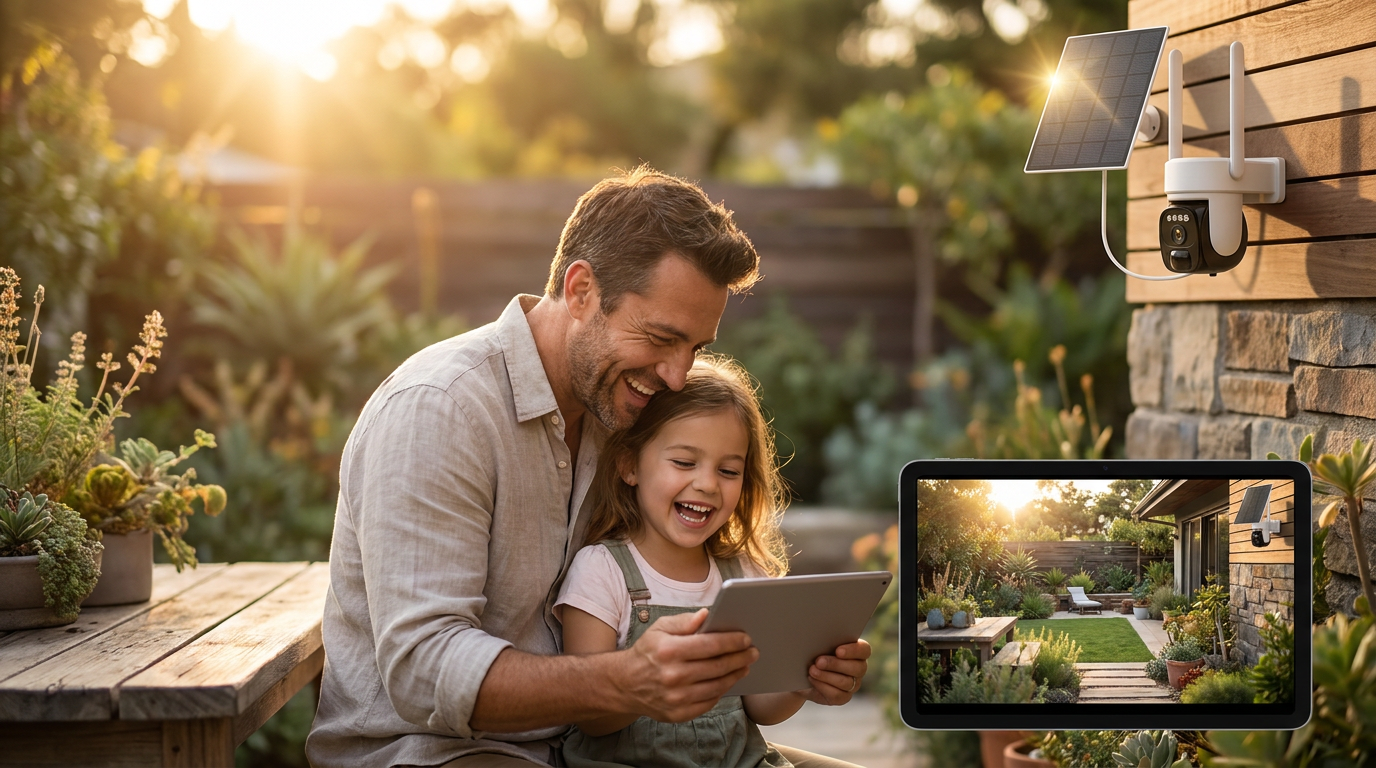
Five-Step Outdoor Solar Security Camera WiFi Deployment
 Maya ChenContributing Editor
July 14, 2026 — The market for the Outdoor Solar Security Camera is currently saturated with low-cost units that prioritize marketing buzzwords over sustained network reliability. While the industry pushes for higher resolution, the real friction point remains the intersection of PIR sensitivity and consistent WiFi handshake protocols.
The conventional wisdom says that any solar-powered unit can be placed anywhere with sunlight, but this ignores the high energy cost of frequent WiFi wake-up cycles triggered by false motion events. According to technical specifications from Ctronics, a 2K 3MP camera utilizing a 7800mAh battery requires precise AI/PIR detection to prevent the battery from depleting during high-traffic periods or overcast weeks. Without a rigorous deployment strategy, these devices often become expensive paperweights by the third day of low light.
The 5-Step Performance Protocol
Photo by Marek Piwnicki on Pexels
Effective deployment of an outdoor motion sensor solar camera wifi system starts with a signal stress test before the bracket ever touches the wall. First, installers must map the 2.4GHz interference levels at the mounting site; a camera that constantly hunts for a signal will drain a 7800mAh battery 40% faster than one with a stable -60 dBm connection. Second, the PIR (Passive Infrared) sensor must be angled to avoid heat-signatures from paved surfaces, which trigger false recordings. Third, the solar panel requires a minimum of four hours of unshaded peak sun to maintain a positive charge-to-discharge ratio. Fourth, the local storage or cloud sync interval should be set to 15-second clips to preserve bandwidth. Finally, firmware must be locked to prevent background updates from initiated during low-battery states. Run the math: a system like the OHWOAI 6-camera kit, priced at $399.99, requires significant planning to ensure all six nodes maintain connectivity without one becoming a weak link that drags down the localized network throughput. Whether you are scaling your outdoor solar security camera system or just setting up a single unit, these steps are non-negotiable for uptime.
Expert tip: Use a dedicated 2.4GHz guest SSID for your cameras to isolate high-bandwidth security traffic from your primary home network, ensuring that PIR-triggered uploads don't compete with 4K streaming or work-from-home tasks.
For those managing temporary housing, an easy install solar camera for renters offers a simplified version of this protocol, though the physics of signal attenuation remain the same. Before purchasing hardware, consult the three-axis framework for outdoor solar security camera selection to match your specific environmental light levels with the appropriate battery capacity. I'll change my mind when manufacturers start including external high-gain antennas as a standard rather than an afterthought.
Shop Outdoor Solar Security Camera.