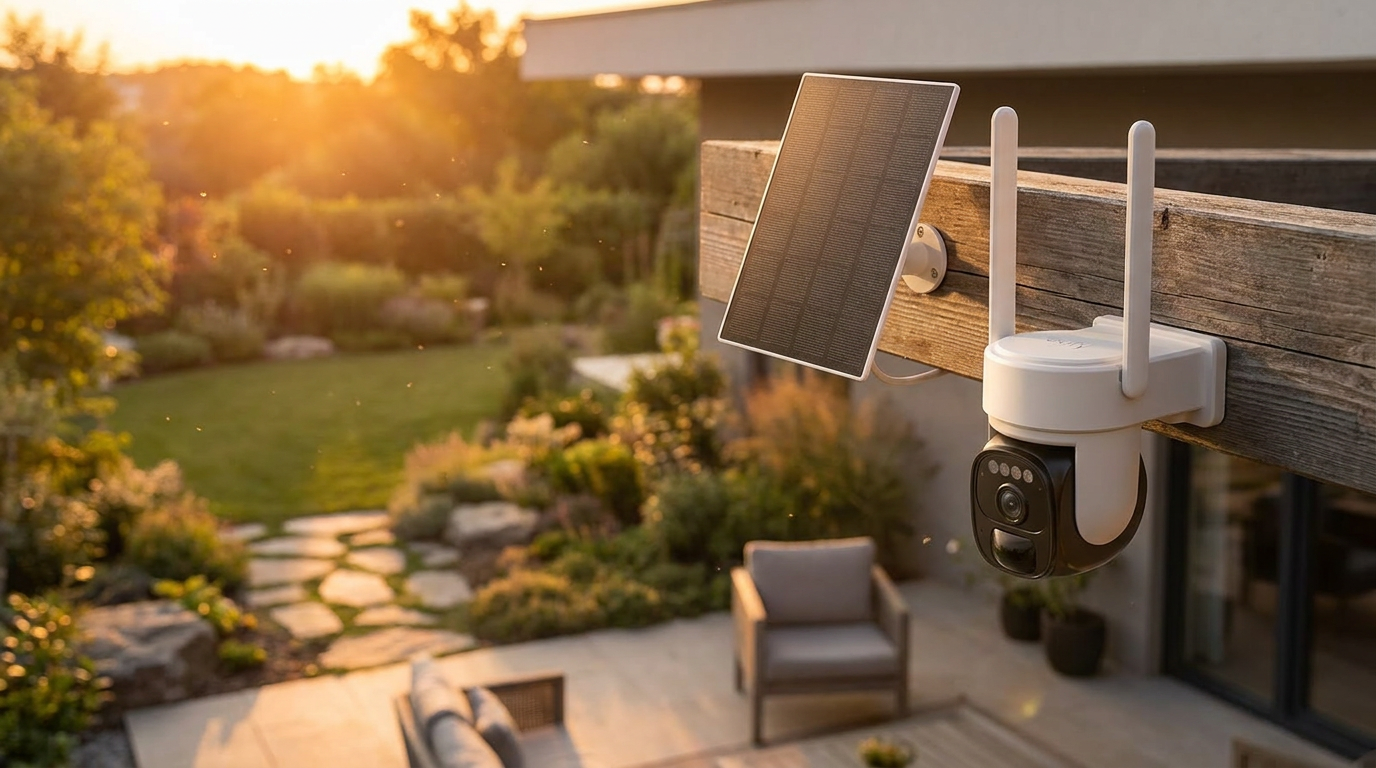
Eufy SoloCam S340 Solar Limits and PTZ Power Consumption
 Maya ChenContributing Editor
June 14, 2026 — The market for autonomous surveillance is expanding with the eufy SoloCam S340, a dual-lens solar-powered unit designed to eliminate manual charging. While recent reviews highlight its integrated panel and pan-tilt capabilities, the reality of maintaining a 24/7 security perimeter without a hardwire connection remains mathematically fraught for high-traffic areas.
The conventional wisdom says that a solar-powered camera with a $259.99 CAD MSRP is a 'set-it-and-forget-it' solution. According to iPhone in Canada, the SoloCam S340 is currently positioned as a mid-range option, even seeing promotional discounts as low as $189.99 CAD. However, here's the part nobody talks about: the energy tax of Pan-Tilt-Zoom (PTZ) functions. Every time the motor engages to track a subject or reposition the lens, it depletes a battery that relies on a relatively small surface area for solar collection. For users in northern latitudes or shaded residential spots, the 'forget-it' part of the marketing quickly turns into a 'recharge-it' reality.
Photo by RDNE Stock project on Pexels
Run the math: A standard Outdoor Solar Security Camera requires consistent lux levels to maintain its wireless WiFi connectivity and color night vision sensors. If you are utilizing the two-way audio and frequent PTZ rotations, the discharge rate often outpaces the 2.2W to 5W input typical of integrated panels. This is why professional installations often favor a high-efficiency solar panel setup over integrated units. When assessing PTZ vs fixed lens options, one must account for the mechanical overhead of movement.
Expert tip: To maximize the lifespan of a solar-powered PTZ unit, disable 'auto-tracking' in high-traffic zones. Instead, use the dedicated app to set specific 'guard points.' This reduces motor activity while still allowing you to monitor residential security zones effectively without draining the battery by noon.
Data from iPhone in Canada suggests the S340 is a robust contender for those seeking dual-lens clarity, but it does not exempt the owner from monitoring power levels via the app. Many users overlook the fact that cloud storage bandwidth also impacts battery life, as the WiFi radio stays active longer to upload high-resolution footage.
I’ll change my mind when integrated solar conversion rates exceed 30% efficiency in sub-optimal lighting conditions. Until then, these remain supplemental tools rather than primary security pillars for high-risk zones.
Shop Outdoor Solar Security Camera