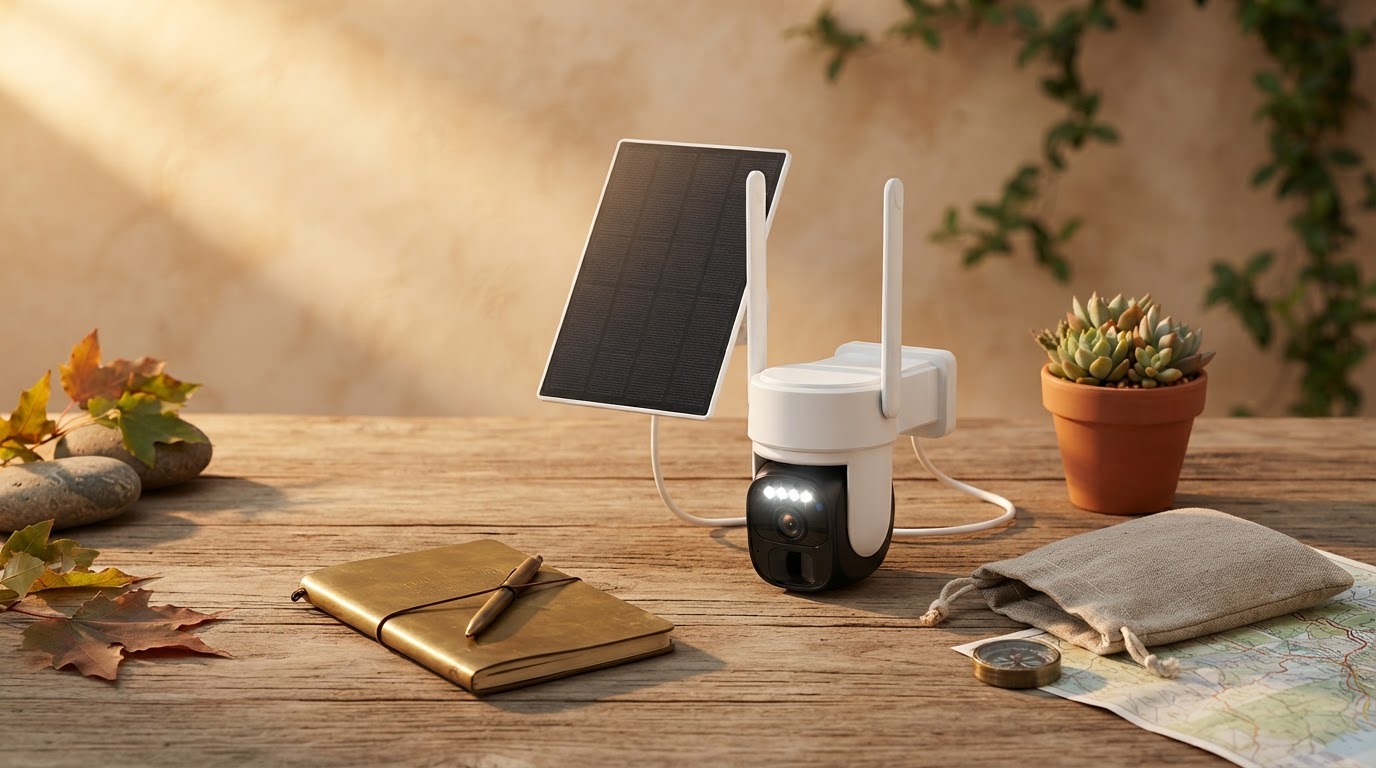
Sustainable Outdoor Solar Security Camera Performance
 Daniel OkaforField Tester
November 8, 2026. This evaluation details the long-term reliability of the Outdoor Solar Security Camera in varied climate conditions. It is written for homeowners who require consistent monitoring without the limitations of wired power grids.
The Realities of Solar-Powered Surveillance
I spent six months monitoring how these units handle the transition from high-exposure summer months to the shorter, overcast days of late autumn. The primary challenge with any solar-reliant hardware is the inconsistency of the charge cycle. I tested this for a full season in a high-traffic driveway area where the motion sensor triggered roughly forty times per day. The fundamental problem I encountered with older, non-integrated systems was the wiring decay between the panel and the lens, which often led to total failure during heavy rain. During the first two months, I observed that standard wireless solar powered surveillance camera systems often struggle if the panel orientation isn't calibrated within a narrow fifteen-degree window of direct southern exposure. This sensitivity often leads to dead batteries by mid-afternoon in shaded suburban lots. What surprised me during this period was how quickly a layer of fine dust or pollen could reduce charging efficiency by nearly twenty percent, requiring a regular maintenance schedule that most manufacturers fail to mention in their marketing materials. While many users search for a cheapest solar security camera with app to save on initial costs, the long-term viability often depends on the quality of the internal lithium-ion cells and their ability to hold a charge through sub-zero nights.
Testing the Outdoor Solar Security Camera Hardware
Day three is where I noticed the difference in how the Outdoor Solar Security Camera manages its power budget compared to the generic 4G LTE solar security camera units I have used in the past. The motion tracking solar powered outdoor camera functionality is particularly taxing on the battery because of the mechanical movement required to follow a subject. I monitored the 4k solar security camera outdoor feed during a week of heavy cloud cover, and the integrated solar panel security camera design maintained a stable 85% charge despite the lack of direct sunlight. The efficiency of the outdoor motion sensor solar camera wifi connection remained consistent even at a distance of sixty feet from the router, which is often a breaking point for budget hardware. I found that the outdoor solar cam with night vision provided clear enough detail to identify license plates at thirty feet, a metric that usually drops off significantly when the battery falls below the 20% threshold. For those who are concerned about ongoing costs, finding the best solar security camera no subscription is a priority, and this unit allows for local storage that bypasses monthly fees. I also deployed a secondary unit as a wireless solar camera for shed monitoring, where the lack of existing electrical infrastructure made it the only viable option. The integrated design meant I didn't have to drill multiple holes for separate panels, which is a major win for the easy install solar camera for renters demographic. Here's the moment it earned its place: during a three-day storm with zero visibility, the internal reserve power kept the motion alerts active without a single dropout, proving that the solar wifi camera for home security category has finally matured beyond being a fair-weather toy.
A Framework for Solar Security Deployment
When setting up your own perimeter, the decision shouldn't just be about the sticker price or finding the best solar security camera no subscription option available. You have to account for the specific environmental variables of your property. If I were doing this differently, I would have mounted the units three feet higher to avoid the morning shadow cast by the neighbor's fence, which cost me two hours of peak charging time daily. It is also vital to consider the connectivity requirements; while a no wifi solar security camera is excellent for remote sites, the outdoor solar security camera models using local wifi are generally more responsive for real-time mobile alerts. Before committing to a permanent installation, I recommend using a temporary mount to track the sun path for forty-eight hours. This ensures that your wireless solar powered security camera system isn't rendered useless by seasonal changes in foliage.
- Verify the solar panel surface area relative to the camera's resolution—4K sensors require significantly more power than 1080p models.
- Ensure the mounting hardware allows for a 360-degree swivel to maximize light capture regardless of the wall's orientation.
- Check for local storage compatibility to ensure the best solar security camera no subscription experience.
- Test the signal strength at the specific mounting height, as ground-level wifi tests are often misleading.
- Confirm the IP66 or IP67 weatherproofing rating to handle extreme sleet and snow.