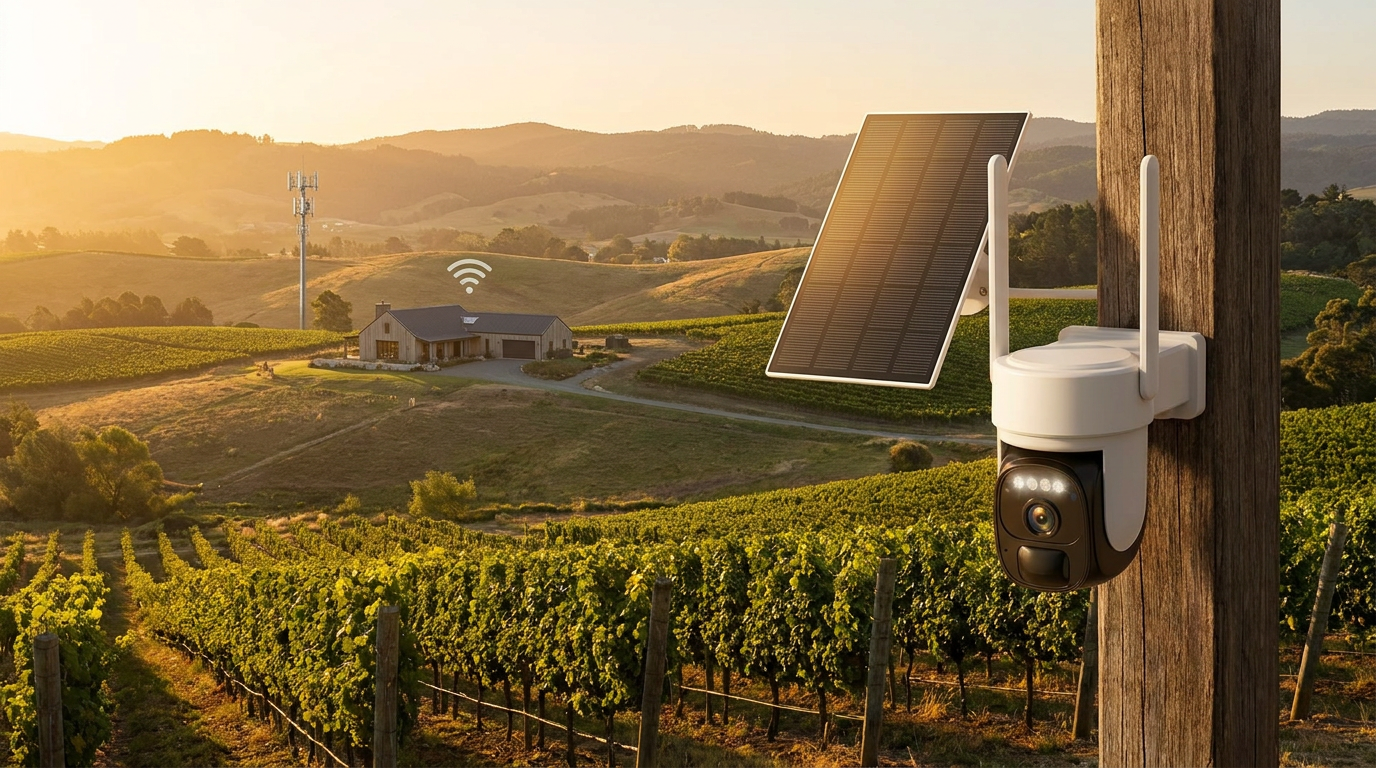
Three Connectivity Tiers for Outdoor Solar Security Camera
 Priya RamanSenior Analyst
June 8, 2026 — The expansion of cellular infrastructure has redefined the deployment of the Outdoor Solar Security Camera, shifting the focus from local network range to global accessibility. As property owners seek to monitor assets beyond the reach of traditional routers, the 4G LTE solar camera has emerged as the primary alternative for reliable, high-bandwidth data transmission.
Remote surveillance technology now operates on a distinct connectivity matrix. According to Reolink, cellular security cameras provide a robust solution for locations without Wi-Fi, offering features like remote viewing and smart detection within a rugged outdoor design. This transition allows for the protection of sites that were previously considered "dark zones" due to a lack of power and internet infrastructure.
The Connectivity Efficiency Framework
When evaluating an Outdoor Solar Security Camera for remote use, two axes matter here: data reliability and power conservation. Think of it as a matrix of signal availability versus energy consumption. In the first tier, standard Wi-Fi models offer high speed but limited range, often requiring an additional wireless solar camera for shed setup to bridge the gap between structures. The second tier involves 4G LTE integration, which utilizes cellular SIM cards from providers like Verizon, AT&T, or T-Mobile to maintain a persistent link. For instance, the Xega 4G Outdoor Wireless Solar Powered Camera delivers 2K HD resolution and 355-degree rotation entirely over cellular bands, bypassing the need for a local network. The third tier focuses on specialized remote monitoring, such as the Vosker V150, which is specifically engineered for long-term deployment in areas where human intervention is rare.
This framework is particularly vital when considering solar security camera winter performance, as the energy cost of maintaining a 4G connection is higher than Wi-Fi. A 4G LTE camera typically requires a larger solar panel or a higher-capacity battery to ensure the cellular modem does not deplete the system during low-light weeks. For a solar camera for off grid property, the internal battery capacity must be matched against the daily data upload frequency. Once you see it this way, the choice becomes a matter of balancing the necessity of real-time alerts against the solar recharge rate of the specific geographic location.
Expert tip: Always check the peak power draw of the 4G modem; high-bitrate streaming on a cellular Outdoor Solar Security Camera can consume up to 20% more battery than local recording during periods of frequent motion triggers.
The decision rule: Choose 4G LTE when the distance from the nearest router exceeds 150 feet or when monitoring a solar camera for off grid property where infrastructure is non-existent.
Shop Outdoor Solar Security Camera
Sources
Photo by Atypeek Dgn on Pexels
- Xega 4G LTE Cellular Security Cameras Wireless Outdoor Solar ...
- V150 » VOSKER | Mobile Security Cameras
- Best Cellular Security Camera | 4G LTE CCTV Solutions - Reolink US