A Four-Point Setup for Outdoor Solar Security Camera Use
 Jordan HaleStaff Writer
November 3, 2026 — The rising demand for agricultural asset protection has accelerated the adoption of the Outdoor Solar Security Camera as a primary defense for remote acreage.
Standing at the edge of a north-pasture fence line, I could feel the biting November wind, but the hardware in my hand felt surprisingly substantial and ready for the elements. In remote environments where the nearest router is miles away, the challenge isn't just power—it is the data bridge. It turns out that modern agricultural surveillance no longer requires a wired backbone. According to research from Eufy, 4G cellular cameras equipped with solar panels are now the preferred solution for farmers watching livestock or equipment in areas where traditional internet infrastructure simply doesn't exist.
The Four-Point Remote Deployment
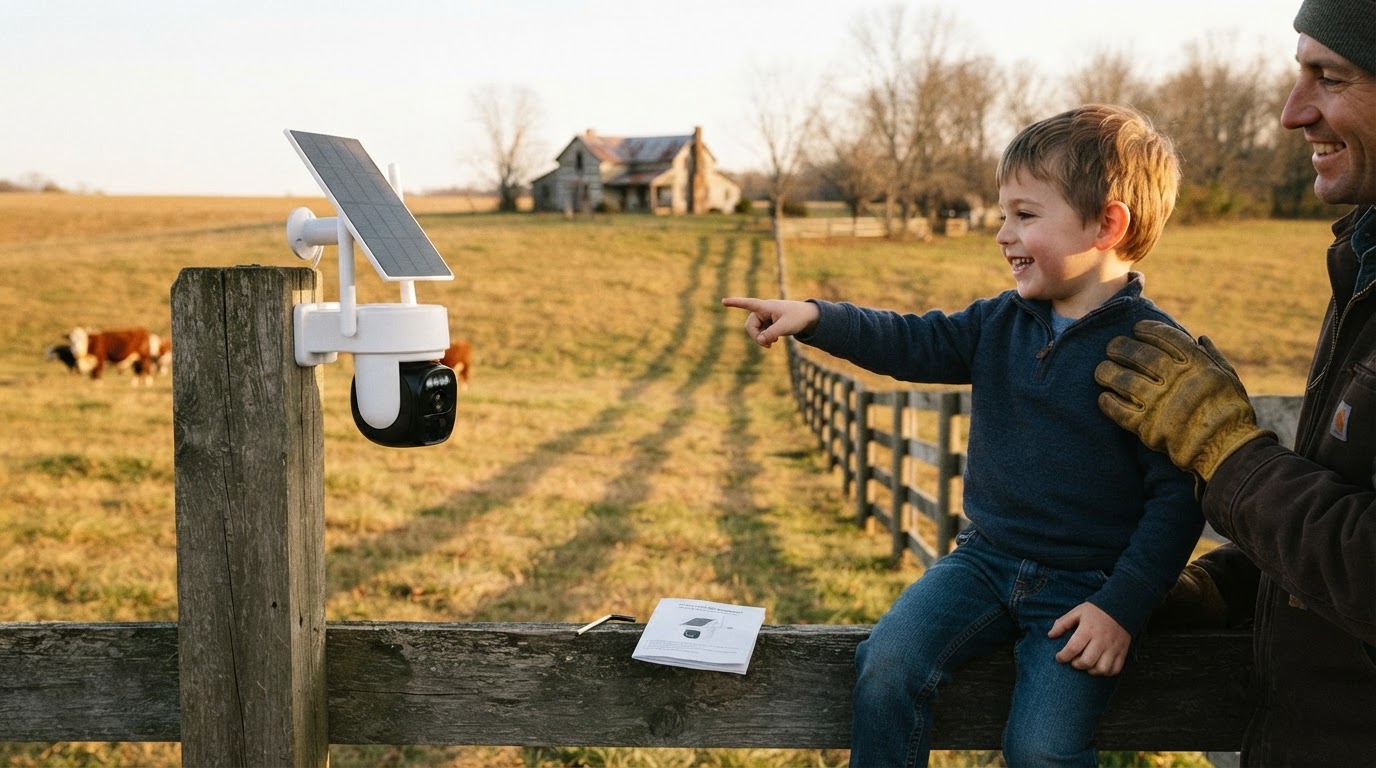
The first thing I noticed was how critical placement becomes when you are relying entirely on the sun and a SIM card. To ensure a successful installation, you must first verify the 4G LTE signal strength at the specific pole or structure where the Outdoor Solar Security Camera will live. A single bar of signal might suffice for static images, but fluid motion tracking requires a stable connection. Second, the orientation of the integrated solar panel must be optimized for the winter solstice; even a slight 15-degree tilt toward the equator can be the difference between a dead battery and 24/7 uptime. Third, you must configure the PIR (Passive Infrared) motion sensors to filter out livestock movement if your primary goal is detecting human intruders, which preserves both battery life and data plan limits. Finally, local storage via high-endurance SD cards provides a necessary fail-safe. If the cellular network dips during a storm, the unit continues to record locally, ensuring no gaps in your security timeline. These units typically feature IP66 weather resistance to withstand heavy rain and dust, alongside night vision capabilities that reach up to 30 feet in total darkness, making them self-sufficient sentinels for the back forty.
Expert tip: When deploying in high-wind farm environments, use a dual-bolt mounting bracket rather than the standard single-screw swivel to prevent 'image jitter' which can trigger false motion alerts and drain your 4G data allowance.
Deploying a no wifi solar security camera is the most effective way to bridge the gap between rural isolation and modern peace of mind. For those managing larger tracts, selecting an outdoor solar security camera for off grid use requires balancing the hardware's power consumption with the available sunlight in your region. I keep coming back to the simplicity of these systems; once the SIM is active and the panel is angled, the tech fades into the background. If you are looking for a solar surveillance camera for remote locations, the key is choosing a model that supports multi-carrier 4G bands. Understanding the nuances of a solar camera for off grid property will save hours of troubleshooting during the winter months.
Shop Outdoor Solar Security Camera.
Sources
- What are reliable solar security cameras without WiFi for off-grid use?
- Security Camera That Works Without WiFi or Internet - eufy US
- Security Cameras Without WiFi | No Internet Cameras - Reolink US