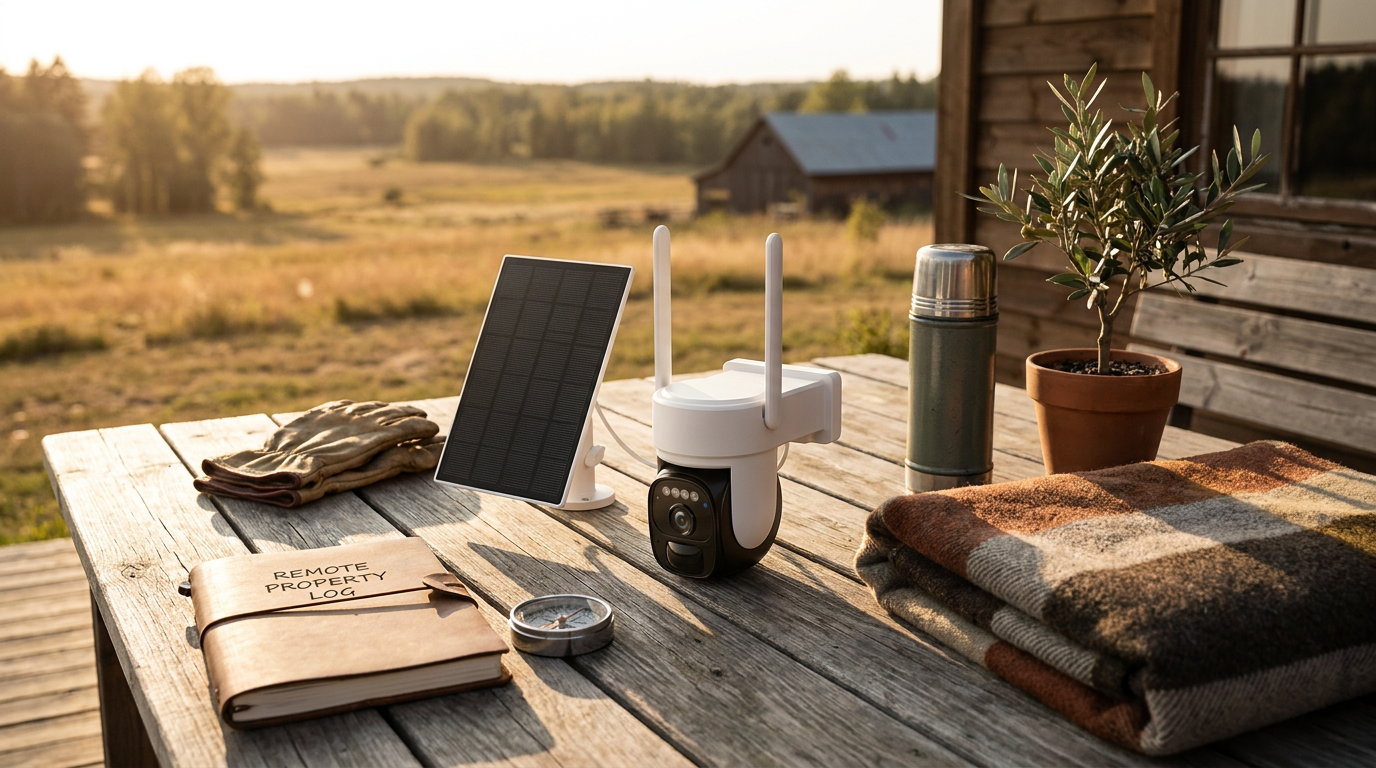
Applying Outdoor Solar Security Camera Tech to Remote Property
 Maya ChenContributing Editor
June 20, 2026. This analysis examines the operational reality of deploying high-uptime surveillance in environments without grid power. It is written for property managers and homeowners who require consistent monitoring in areas where traditional wiring is cost-prohibitive.
The Efficiency Gap in Off-Grid Surveillance
The conventional wisdom says that any panel-equipped device can maintain 24/7 uptime as long as the sun is shining. This ignores the reality of seasonal solar cycles and the specific energy draw of high-definition sensors. According to SafeHome.org, industry leaders like ADT and Lorex have integrated solar-powered options into their ecosystems, but these still rely heavily on the underlying battery capacity to bridge the gap during overcast periods. Here's the part nobody talks about: many consumer-grade units fail not because of the camera hardware, but because the surface area of the included solar panel is mathematically insufficient to recharge the battery at the same rate the motion sensor depletes it. When looking at solar powered security cameras, the bottleneck is almost always the conversion efficiency of the photovoltaic cells during the shorter days of winter. Reddit discussions frequently highlight this issue, with users reporting that a wireless solar camera for a shed often requires manual USB charging by mid-January if the motion frequency is high. The consensus suggests that 'set and forget' is a marketing myth; in reality, placement requires a precise calculation of peak sun hours versus trigger events per day.
Redefining Reliability with Outdoor Solar Security Camera Systems
Photo by Martin.que on Pexels
To achieve consistent performance, an Outdoor Solar Security Camera must move beyond the standard 2-watt panel. For remote properties where Wi-Fi signals do not reach, the integration of cellular connectivity is the only viable path forward. The 4g lte solar security camera solves the distance problem but introduces a higher power draw due to the constant cellular handshake. Run the math: a standard 4G module can consume up to three times more power than a low-power Wi-Fi chip during data transmission. This is why the Outdoor Solar Security Camera focuses on high-capacity internal storage and intelligent PIR (Passive Infrared) sensors that ignore ambient environmental movement to conserve energy. While many seek a no wifi solar security camera for deep-woods monitoring, they often overlook the data overhead. The current hardware standards for solar powered security cameras now emphasize multi-crystalline panels that can still harvest energy in low-light conditions. Furthermore, the outdoor motion sensor solar camera wifi variants are increasingly using localized AI processing to reduce the frequency of cloud uploads, which is the most energy-intensive task a camera performs. By keeping the heavy lifting on the device, the system preserves its battery for critical alerts rather than background noise.
A Technical Framework for Camera Selection
Photo by Andrey Matveev on Pexels
Selecting hardware based on star ratings is a flawed methodology that ignores environmental variables. A successful deployment requires an audit of the installation site's specific constraints. If the location lacks a stable 2.4GHz signal, the search must pivot exclusively to a 4g lte solar security camera to avoid dead zones. SolarReviews notes that even highly-rated hardware like the Ring Stick Up Cam Solar, which earned 4.6 stars, is only as effective as its placement allows. For those requiring 360-degree coverage, the solar powered security cameras category now includes PTZ (Pan-Tilt-Zoom) models. As discussed in recent comparisons of the eufyCam S4 and Tapo series, PTZ functions add another layer of mechanical power consumption that must be accounted for in the solar budget.
Deployment Checklist:
- Verify the daily peak sun hours for the specific GPS coordinates of the installation.
- Calculate the required PIR sensitivity to prevent false triggers from wind or shadows.
- Ensure the cellular or Wi-Fi gateway is within the hardware's effective transmission range.
- Confirm the battery's operating temperature range matches local winter lows.
- Match the data plan to the expected frequency of high-definition video clips.
Shop Outdoor Solar Security Camera here.