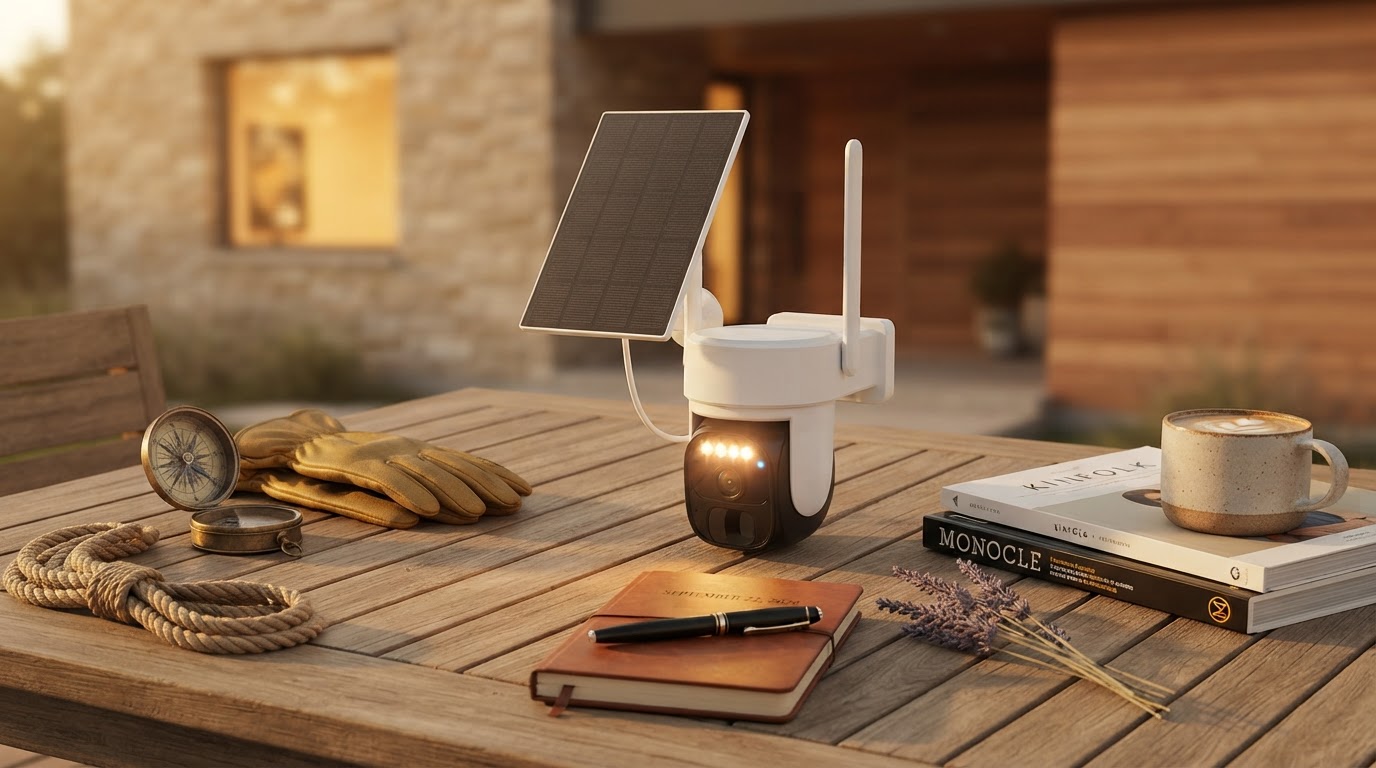
Outdoor Solar Security Camera Motion Light Integration
 Maya ChenContributing Editor
October 26, 2026. This analysis examines the technical efficiency of combining high-intensity illumination with solar-powered surveillance hardware. It is intended for property owners evaluating the trade-off between active lighting and battery longevity in wireless security systems.
The Power Drain of Integrated Illumination
The conventional wisdom says that more lumens necessarily equal better security, but this ignores the finite energy budget of a self-contained solar unit. Most consumers prioritize high-brightness floodlights without calculating the impact on the camera’s uptime during consecutive overcast days. According to Eufy, a solar security camera with light must balance the energy consumed by the LEDs against the power required for continuous motion detection and Wi-Fi transmission. When a device triggers a 1000-lumen burst, it draws significantly more current than the camera sensor itself. This creates a vulnerability: a high-traffic area might trigger the light so frequently that the battery reaches a critical shutdown state by midnight, leaving the property unmonitored until the next solar cycle. This is particularly problematic for users seeking a motion sensor solar floodlight camera where the light is the primary deterrent. Data from MAXSA Innovations indicates that while some solar-powered security video cameras and spotlights have dropped in price to under $100, the physical size of the solar panel often remains the bottleneck for these dual-purpose machines. If the panel cannot generate more than 5W of peak power, the integrated light effectively acts as a parasitic drain on the core security function.
Technical Performance of Outdoor Solar Security Camera Systems
Outdoor Solar Security Camera hardware must solve the problem of power density by utilizing high-efficiency monocrystalline panels and optimized PIR (Passive Infrared) sensors. The current market standard for an all-in-one solar camera with floodlight involves 2K resolution sensors paired with adjustable LED arrays. For instance, testing by Reolink, as documented in their technical reviews, shows that high-performance motion detectors can support two adjustable LED floodlights outputting up to 1000 lumens while maintaining a 2K video stream. However, the efficacy of these systems relies heavily on the 4G LTE or Wi-Fi connectivity stability. Research context queries show a high demand for 4G LTE solar security cameras and no-wifi solar security cameras, suggesting that users are increasingly deploying these units in remote locations like sheds or perimeter fences where grid power is unavailable. In these scenarios, the integrated motion light serves a dual purpose: providing color night vision for the camera and acting as a physical deterrent. Run the math: a standard 2800-lumen LED array, such as those found in Wyze’s high-output lighting cameras, requires a substantial battery reserve to avoid total system failure. The Outdoor Solar Security Camera approach prioritizes integrated solar panels that minimize resistance losses found in external cabling, though this requires precise positioning to ensure the panel faces the solar noon trajectory. Users often overlook that a motion sensor solar floodlight camera installed under an eave will lose up to 40% of its charging potential, regardless of the LED efficiency.
Strategic Deployment and Decision Framework
Here's the part nobody talks about: an integrated solar motion light with a camera is only as effective as its recovery rate. If the device takes twelve hours of direct sunlight to recover from one hour of LED activation, the system is fundamentally flawed for high-traffic residential use. A successful deployment requires matching the lumen output to the specific square footage of the target zone rather than chasing the highest possible number. When selecting an all-in-one solar camera with floodlight, the focus should remain on the PIR sensor's ability to distinguish between environmental noise and actual threats to prevent unnecessary light triggers. I’ll change my mind when battery energy density improves to the point where 3000-lumen bursts don't compromise the 24/7 monitoring capabilities of a 4K sensor. Until then, the most reliable units are those that allow for granular control over light duration and brightness levels.
Before finalizing an installation, use this technical checklist:
- Verify the solar panel wattage meets or exceeds 5W for units with lights over 500 lumens.
- Confirm the PIR detection range matches the light throw to avoid recording dark frames.
- Select a model with customizable activity zones to prevent street traffic from triggering the floodlight.
- Prioritize units with large internal lithium-ion buffers (minimum 10,000mAh) for winter performance.
- Ensure the motion sensor solar floodlight camera supports low-power standby modes when motion is not detected.
- Check for IP65 or higher weatherproofing to protect the integrated LED housing from moisture ingress.
To ensure your property remains protected with high-efficiency lighting and 2K surveillance, Shop Outdoor Solar Security Camera here.
Sources
- Motion Activated Solar-Powered Lights/Cameras - MAXSA Innovations
- Solar Security Light + Camera — No Wiring Needed Reolink Test
- Lighting Cameras | Floodlight & Spotlight Cameras - Wyze