Can an Outdoor Solar Security Camera work without WiFi?
 Priya RamanSenior Analyst
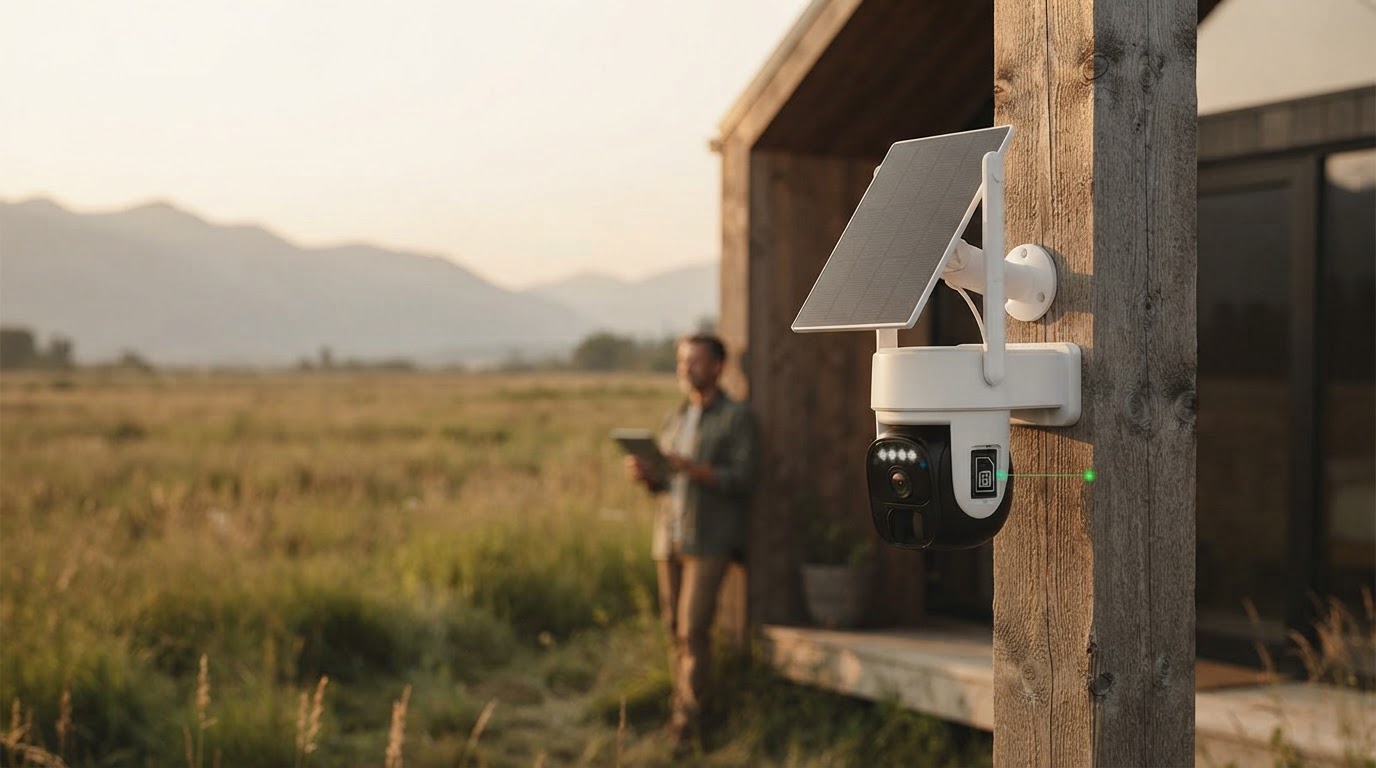
September 3, 2026 — An Outdoor Solar Security Camera can operate entirely without a WiFi network by utilizing cellular data (LTE/4G) or local storage, provided the hardware includes a compatible SIM card slot or high-capacity SD card module.
Property owners managing remote assets, such as construction sites, rural acreage, or detached sheds, frequently encounter the limits of standard wireless networking. When traditional routers are out of range, the security framework shifts from local network dependency to cellular or localized data architectures. Understanding these options requires viewing the hardware through two axes: connectivity (cellular vs. local) and power autonomy (solar-integrated vs. battery-only).
How do Outdoor Solar Security Cameras connect without WiFi?
The decision rule for connecting a camera without WiFi depends on whether you require real-time remote monitoring or simply need to review footage after an event. Most professional-grade units designed for this purpose, such as the eufy 4G LTE Cam S330, utilize a cellular SIM card to transmit data over the same networks used by smartphones. This allows the camera to function as a standalone communication hub that does not rely on a central router. Once you see it this way, it becomes clear that the camera acts less like a peripheral and more like an independent mobile device.
Evidence from industry testing by Security.org indicates that brands like Arlo Go and Lorex are top picks for this specific use case, leveraging cellular data to maintain a live link in areas where broadband is unavailable. For users who do not need live alerts, some cameras can be configured to record exclusively to internal microSD cards. However, for most modern applications, the solar powered security camera no wifi model relies on 4G LTE to provide the same level of responsiveness as a standard home system.
Are cellular solar cameras reliable for remote surveillance?

Photo by Jan van der Wolf on Pexels
Reliability in off-grid environments is determined by a matrix of signal strength and energy management. For remote locations, the Outdoor Solar Security Camera must balance the high energy demands of a cellular modem with the limited intake of a small solar panel. Manufacturers like Hikvision and Uniden have optimized this balance by developing cameras that remain in a low-power "sleep" state until motion is detected, at which point the cellular radio activates to send a notification. Think of it as a matrix of power conservation versus immediate awareness.
Research published by VOSKER highlights that these wire-free systems are specifically engineered for jobsites and remote properties where 24/7 monitoring is required without existing infrastructure. Because these cameras are 100% wire-free, they eliminate the vulnerability of physical line cutting. To ensure consistent performance during winter or low-light periods, many outdoor solar security camera remote locations setups now include larger, detached solar panels to maximize UV absorption, ensuring the cellular modem never loses power during a critical transmission.
Quick answers
Q: Do I need a separate data plan for a 4G solar camera? A: Yes, most cellular-enabled cameras require a monthly or annual data plan from a provider like Verizon, AT&T, or T-Mobile, similar to a smartphone. Some brands like VOSKER include a pre-activated SIM card with tiered data options based on the number of photos or videos transmitted.
Q: Can a solar camera record if the cellular signal is lost? A: Most high-end units feature an onboard SD card slot that acts as a fail-safe; for example, the eufy S330 can store encrypted footage locally even if the 4G connection is interrupted, syncing the data once the signal is restored.
Q: How much sun does a no-WiFi solar camera need to stay online? A: While requirements vary by model, most integrated solar panels require approximately 2 to 4 hours of direct sunlight daily to maintain a full charge while powering an active LTE modem. In high-traffic areas, a larger external solar panel may be necessary to offset the increased data transmission power draw.
Q: Is an outdoor solar camera no wifi more expensive than a standard one? A: Generally, yes; the hardware cost is often higher due to the inclusion of cellular modems and specialized antennas, and users must also factor in the ongoing cost of a cellular data subscription, which typically ranges from $5 to $20 per month.
Learn more about Outdoor Solar Security Camera at https://solarsafetycameras.com.
Sources
- What are reliable solar security cameras without WiFi for off ...
- Remote Properties Security Cameras - No Wi-Fi Needed
- Is There a Security Camera That Works Without Wi-Fi?