5-Step Weatherproof Outdoor Solar Security Camera Setup
 Maya ChenContributing Editor
September 16, 2026 — The rising adoption of 4G LTE enabled Outdoor Solar Security Camera systems is fundamentally changing how remote agricultural structures are monitored without existing grid infrastructure. While the conventional wisdom says that standard Wi-Fi extenders are sufficient for outbuildings, the data suggests otherwise for structures located more than 100 feet from a router.
Barn environments present unique challenges including dust, extreme temperature fluctuations, and structural interference. According to Reolink, a truly effective weatherproof barn camera must maintain functionality during heavy snow or rain, often necessitating an IP65 or IP66 rating to prevent moisture ingress. Many property owners mistakenly prioritize high resolution over connectivity, yet a 4K stream is useless if the upload speed at the barn perimeter cannot sustain the bandwidth. For those managing larger operations, securing remote farm acreage with outdoor solar security camera requires a shift toward cellular-based systems that bypass the limitations of local area networks.
The 5-Step Barn Deployment
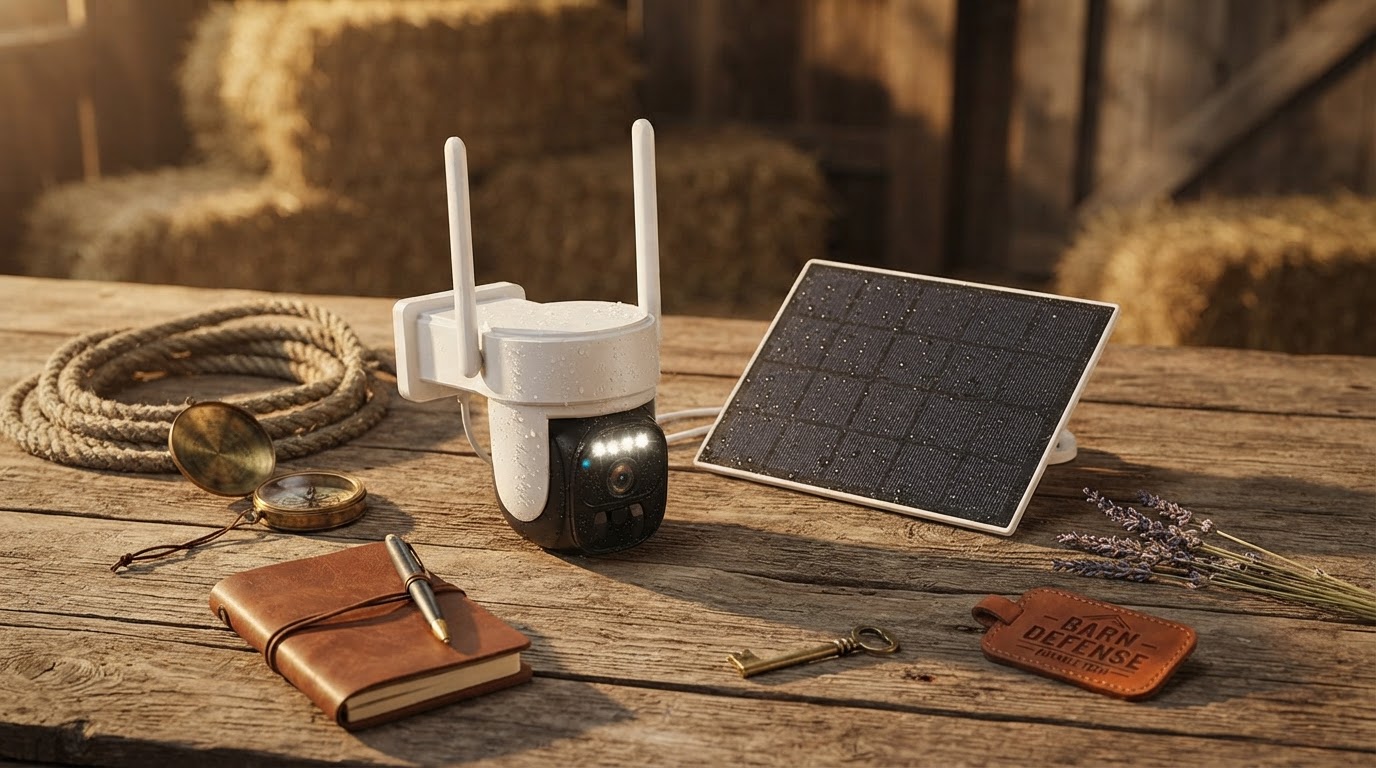
Successful deployment of an Outdoor Solar Security Camera in a barn setting requires a departure from residential installation standards. First, site selection must prioritize the solar panel's southern exposure, ensuring at least six hours of unobstructed sunlight to maintain the internal battery. In areas with high livestock activity, mounting heights should exceed 10 feet to prevent animal interference while maintaining the PIR motion sensor's effectiveness, which typically spans a 30-foot detection radius. Second, connectivity must be verified; for barns outside Wi-Fi range, a wireless solar powered cctv system utilizing a SIM card is the only reliable method to ensure real-time alerts. Third, the hardware must be rated for the specific environmental stressors of a stable. Run the math: a camera with a 6000mAh battery and a 5W solar panel can theoretically operate indefinitely, provided the trigger frequency does not exceed 20 events per day. Fourth, the integration of a diy solar security camera system installation allows for custom positioning of the solar panel away from the camera body, which is critical for barns with significant roof overhangs or interior-facing lenses. Finally, local storage via SD card should be utilized as a fail-safe for cloud-based systems, ensuring footage is captured even during temporary cellular outages. Here's the part nobody talks about: the accumulation of hay dust on the lens and solar panel can degrade performance by up to 30% within a single month, necessitating a scheduled maintenance cycle that most manufacturers downplay.
Expert tip: When installing in livestock areas, disable the siren function and rely solely on push notifications to prevent startling animals, and ensure the PIR sensitivity is tuned to ignore small rodents while capturing larger thermal signatures.
Implementing a wireless solar powered cctv system provides the necessary oversight for calving or equipment protection without the four-figure costs of trenching power lines. I'll change my mind when battery density improves enough to support continuous 24/7 recording on small-form-factor panels, but for now, motion-triggered events remain the only viable path for off-grid barn security.
Shop Outdoor Solar Security Camera.
Sources
- What are good solar powered cameras for barns? - Facebook
- Riverwind® High Definition Wireless Barn Camera System
- Barn Cameras For Your Horse, Stable & Livestock - Reolink