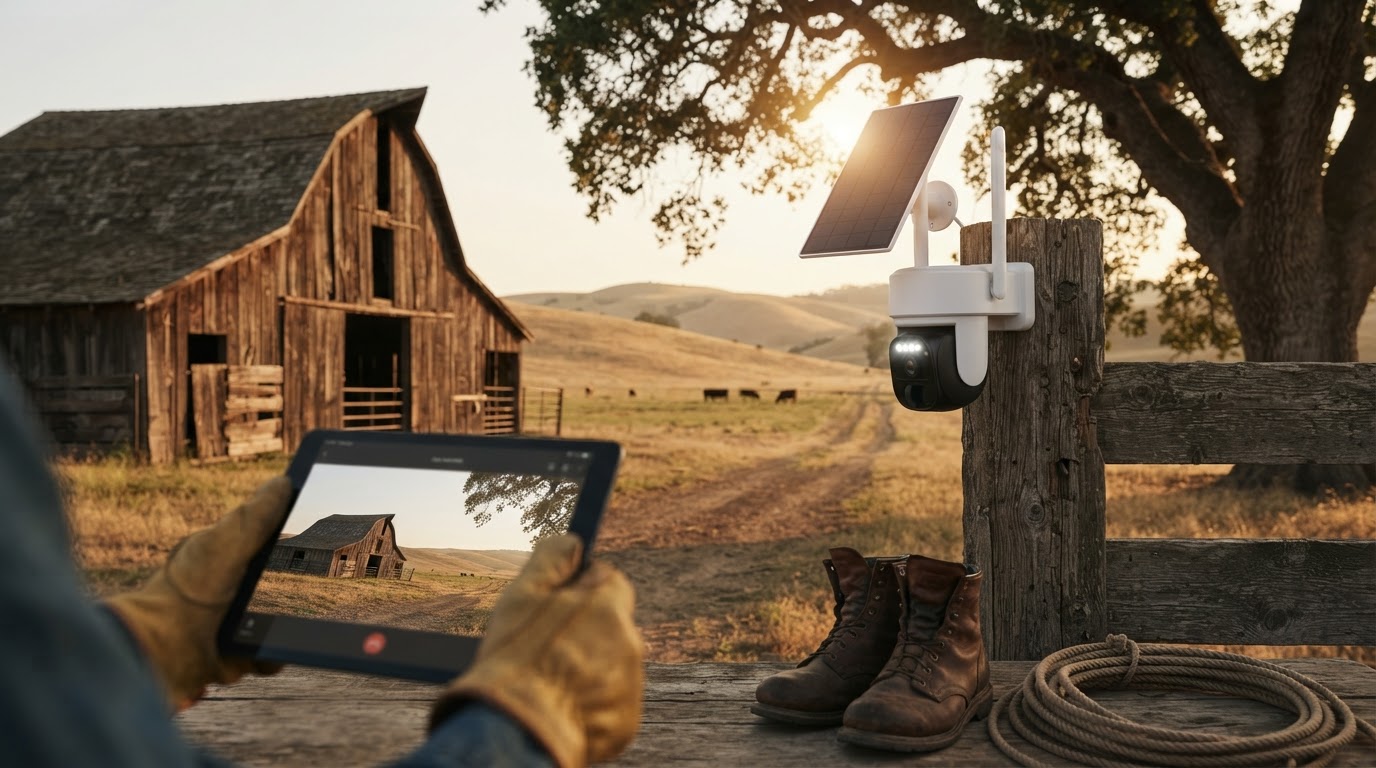
Outdoor Solar Security Camera Solutions for Remote Sites
 Daniel OkaforField Tester
November 5, 2026. This review focuses on deploying a solar surveillance camera for remote locations where traditional power and networking are unavailable. It is written for property owners, farmers, and construction managers who need to maintain eyes on isolated assets without regular site visits.
The Challenge of Monitoring Isolated Assets
I spent six months testing hardware in a high-elevation wooded area where the nearest power line was two miles away. In these environments, the primary hurdle isn't just the lack of a plug; it is the fact that standard consumer electronics aren't built for the power fluctuations of a forest canopy or the data limitations of rural cell towers. According to Reolink US, solar panels keep the camera powered by harvesting energy from sunlight, which is essential for long-term outdoor monitoring in areas like driveways and remote properties. However, I found that "long-term" is a relative term depending on your hardware choice. In my first week, I realized that a standard Wi-Fi camera is useless if the signal can't penetrate a single layer of wet pine needles. This is why selecting an outdoor solar security camera for off grid use requires a specific focus on connectivity rather than just megapixels.
Day three is where I noticed the critical failure point of many entry-level setups: the battery drain during overcast periods. If you are monitoring a site that you only visit once a month, you cannot afford a device that goes dark after two days of rain. Many users looking for a no wifi solar security camera overlook the necessity of a high-capacity internal buffer. I tested this for a stretch of forty-eight hours of continuous sleet, and the difference between a functional unit and a paperweight came down to the efficiency of the integrated solar panel and how the firmware managed deep-sleep cycles between motion events. Without a robust power management system, a remote camera becomes a liability rather than a tool.
Performance Testing in the Field
What surprised me: the reliability of 4G LTE integration over traditional long-range Wi-Fi bridges. When I was setting up a solar powered cctv farm no internet configuration, the cellular-enabled units outperformed the bridged units every time the wind picked up and knocked the antennas out of alignment. The Reolink Go PT Ultra, for instance, utilizes 4G LTE connectivity which Reolink notes is ideal for rural areas and construction sites. In my field tests, this meant I could receive a 4K alert on my phone while I was physically three towns away, provided the local carrier had at least one bar of service. This level of autonomy is what defines a true outdoor solar security camera in a professional context.
During the peak of summer, I monitored the thermal throttling of these units. Many plastic housings warp or trap heat, causing the internal lithium-ion batteries to stop charging as a safety precaution. I monitored a 2K resolution unit with a spotlight, similar to the specs found in Night Owl devices, and found that placement is everything. If the panel is fixed to the camera body, you are often forced to choose between a good view and good sun. Here's the moment it earned its place: I detached the panel using a ten-foot extension cable, mounting the camera under a shaded eave while the panel sat in full sun on the roof. This configuration kept the battery at a steady 95% even while recording high-bitrate video. If I were setting up a solar camera for off grid property again, I would never buy a unit that doesn't allow for a remote-mounted solar panel. The flexibility is non-negotiable for remote sites where the sun doesn't always hit the optimal viewing angle.
Deployment Checklist for Remote Success
When you are miles away from the nearest technician, your initial setup must be bulletproof. I have developed a standard protocol for these installs to ensure the system doesn't fail the moment the first storm hits. If you are deploying a no wifi solar security camera, you need to verify the local carrier's bands before mounting the hardware to the pole. What I'd do differently next time is spend more time testing the PIR (Passive Infrared) sensitivity before leaving the site; a single swaying branch can trigger thousands of false alerts, draining your data plan and your battery in a single afternoon.
- Verify Cellular Signal: Use a signal meter to ensure the 4G LTE band is stable at the exact mounting height, not just at ground level.
- Test Remote Panel Placement: Ensure the solar panel receives at least 4-6 hours of unshaded sun; use extension cables if the camera must be in the shade.
- Calibrate Motion Zones: Mask out moving vegetation to prevent unnecessary wake-up cycles that deplete the battery.
- Format Industrial SD Cards: Use high-endurance microSD cards rated for extreme temperatures, as standard cards often fail in outdoor heat.
- Check Weather Sealing: Apply silicone grease to the charging port gaskets to prevent moisture ingress during high-humidity months.
For those needing reliable surveillance in areas without traditional infrastructure, selecting the right hardware is the first step toward long-term security. Shop Outdoor Solar Security Camera here.
Sources
- Solar-Powered Security Camera for Outdoors | Reolink US
- Best Solar Cameras 2026: Security Expert Reviews - SafeHome.org
- Solar Powered Wire Free 2K Camera with Spotlight and 2-Way Audio - Whi