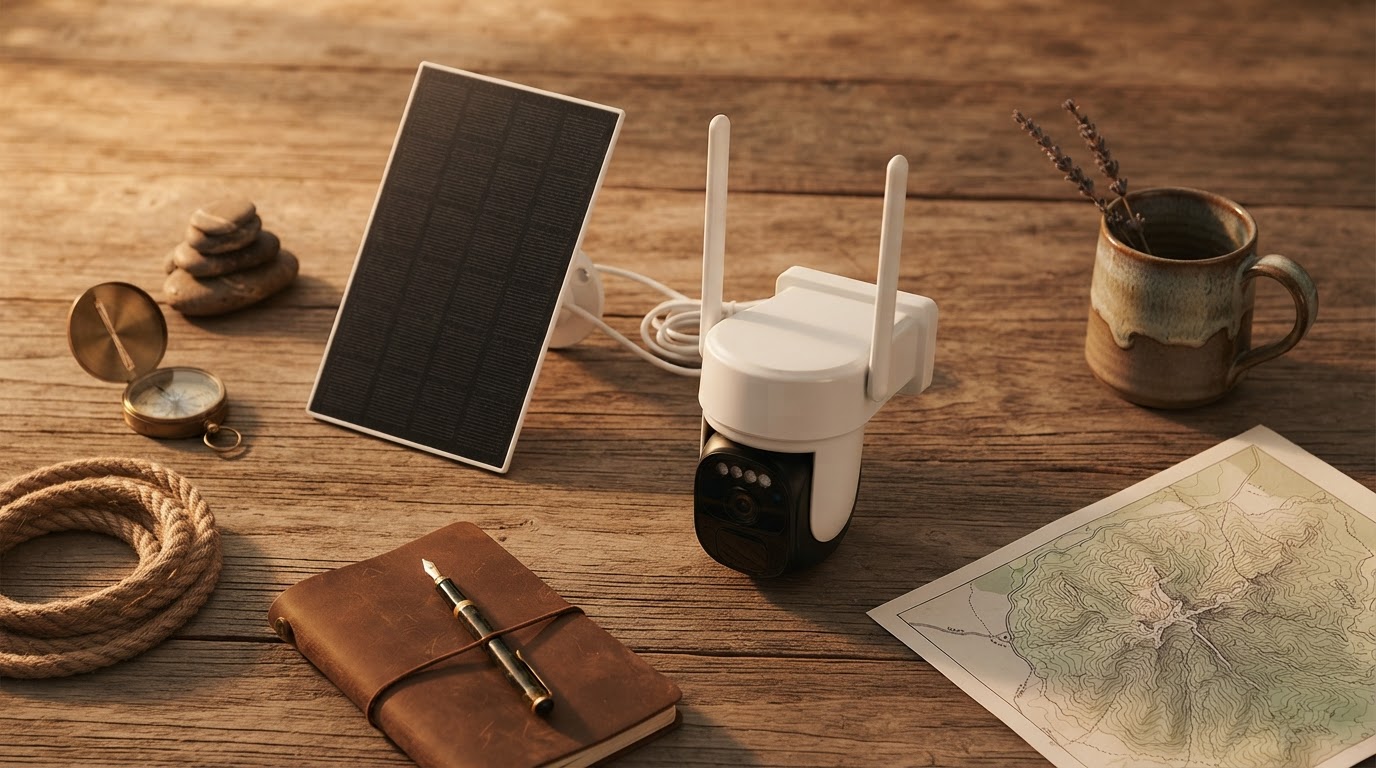
Outdoor Solar Security Camera Solutions for Remote Locations
 Priya RamanSenior Analyst
October 2, 2026. This analysis explores the technical requirements for deploying surveillance in areas lacking electrical infrastructure and traditional broadband. It is designed for property owners, site managers, and rural residents seeking reliable off-grid monitoring.
Securing a remote location requires balancing three critical constraints: power availability, data transmission, and environmental resilience. Think of it as a matrix of energy autonomy and connectivity. In locations where the electrical grid does not reach, a standard wired system is impossible, and even battery-operated units fail due to the logistical burden of frequent recharging. According to SafeHome.org, solar-powered security cameras offer a sustainable alternative by coupling high-capacity batteries with photovoltaic panels to reduce environmental impact and maintenance needs. However, the problem extends beyond power. A camera located on a distant perimeter or a rural acreage often sits outside the range of a standard home router. This necessitates a no wifi solar security camera strategy, where the device must either store data locally or utilize cellular networks. The challenge is ensuring that the camera remains operational during consecutive days of low sunlight while maintaining a link to the user for real-time alerts. Without a structured approach to these variables, remote surveillance systems often suffer from downtime or connectivity gaps that leave the property vulnerable.
Outdoor Solar Security Camera systems address these off-grid challenges through integrated hardware designed for high-efficiency energy capture and diverse data protocols. Two axes matter here: the method of connectivity and the power-to-consumption ratio. For properties where a local network is unavailable, a solar security camera for shed without wifi typically utilizes 4G LTE technology to transmit video. As noted by Reolink US, 4G solar cameras provide cellular connectivity that is ideal for construction sites, farms, and remote properties where traditional internet is non-existent. These units are often equipped with high-resolution sensors, such as 2K or 4K, and motion-tracking capabilities that activate only when activity is detected to conserve battery life. Integrated solar panels allow for a continuous trickle charge, which is vital for maintaining the 24/7 readiness of an outdoor solar camera no wifi setup. Furthermore, models like those from Night Owl incorporate 2K resolution with spotlights and two-way audio, providing a proactive deterrent even in total darkness. By utilizing a no wifi solar security camera with local SD card storage alongside cloud backups via cellular, users can maintain a redundant record of events without needing a physical connection to a base station. The integration of high-efficiency solar cells ensures that even in winter conditions or sub-optimal sunlight, the internal lithium-ion batteries retain enough charge to power motion sensors and night vision infrared arrays.
Selecting the right system requires a rigorous decision framework to ensure the hardware matches the specific environmental demands of the site. The decision rule: prioritize the energy-to-bandwidth ratio based on the frequency of expected motion events. If a site has high traffic, a larger external solar panel is required; for low-traffic remote perimeters, an integrated panel is often sufficient. Once you see it this way, the selection process becomes a matter of matching specs to site geography. When evaluating an outdoor solar camera no wifi for a remote installation, use the following checklist:
- Network Compatibility: Confirm the device supports 4G LTE bands compatible with local carriers if Wi-Fi is unavailable.
- Battery Capacity: Look for a minimum of 5,000mAh to 10,000mAh to sustain operations through 3-5 days of heavy cloud cover.
- Weather Rating: Ensure an IP65 or IP66 rating to protect against dust and high-pressure water jets in exposed areas.
- Storage Redundancy: Select units that offer both on-board microSD storage and encrypted cloud options.
- Trigger Speed: Opt for PIR (Passive Infrared) sensors with a trigger speed under 0.6 seconds to capture fast-moving subjects.
- Resolution and Night Vision: Prioritize 2K resolution and color night vision for actionable forensic evidence.
Shop Outdoor Solar Security Camera here.
Sources
- Solar Security Cameras | Wire-Free Outdoor Protection - Tapo Store
- Solar Powered Wire Free 2K Camera with Spotlight and 2-Way Audio - Whi
- Best Solar-Powered Security Cameras of 2026 - SafeHome.org