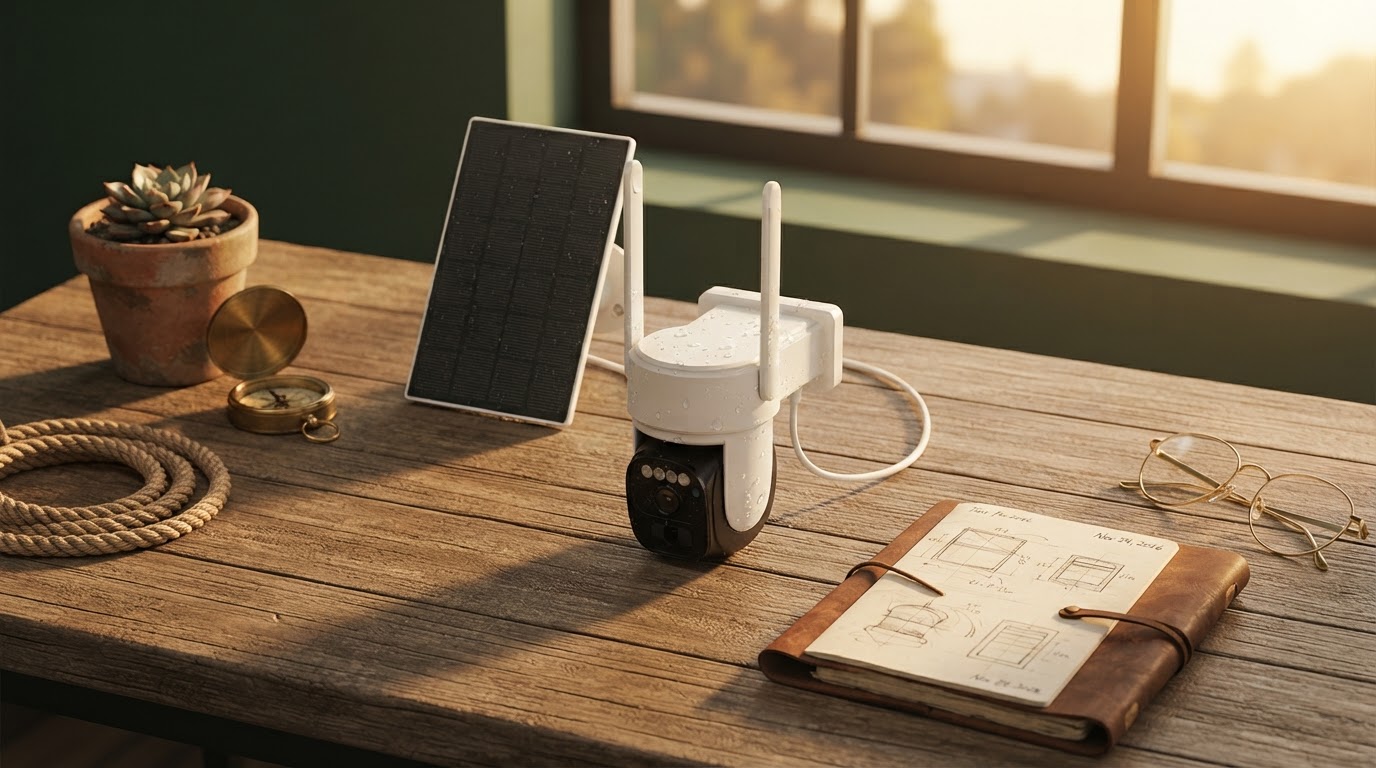
Outdoor Solar Security Camera 24/7 Recording Realities
 Maya ChenContributing Editor
November 24, 2026. Continuous recording on solar-powered hardware represents a significant pivot from the energy-saving motion detection standards that have defined the industry for years. This technical evaluation examines the feasibility of 24/7 capture for property owners who require uninterrupted oversight without hardwiring.
The Energy Deficit in Continuous Surveillance
The conventional wisdom says that solar cameras are strictly for event-based triggers to conserve battery life. While this has been the operational baseline, recent shifts in battery density and panel efficiency are challenging that limitation. However, here's the part nobody talks about: the massive energy gap between recording for 30 seconds a day and recording for 86,400 seconds a day. According to LS Vision, 24/7 surveillance offers peace of mind by capturing events that might not trigger a standard PIR sensor, but this comes at a steep electrical cost. Most consumer-grade units rely on passive infrared sensors to wake the camera from a deep sleep state, a process that consumes milliwatts. By contrast, keeping the image sensor, processor, and Wi-Fi radio active for continuous streaming requires a constant draw that typical small-format solar panels struggle to replenish, especially during low-light months. This challenge is even more pronounced in specific environmental conditions, such as those detailed in our analysis of solar security camera cold weather performance, where battery chemistry faces physical limitations. Run the math: a camera pulling even 2 watts of continuous power requires 48 watt-hours per day. In a typical winter scenario with only 3 hours of peak sunlight, a standard 5W panel will never bridge that deficit. This creates a cycle of deep discharge that can permanently degrade lithium cells within a single season. The industry consensus often ignores these physics in favor of marketing the "always-on" dream, yet the hardware frequently reverts to standby mode once the voltage drops below a critical threshold.
Advancements in Outdoor Solar Security Camera Hardware
Outdoor Solar Security Camera systems are evolving to address this power-to-performance ratio through two specific avenues: increased panel surface area and high-capacity buffer batteries. The Reolink Altas series has entered this space as a notable outlier, functioning as a solar-compatible unit that supports 24/7 recording without the traditional NVR tether. As noted by Reolink, these units utilize larger batteries to bridge the gap during overcast days. For users deploying an integrated solar panel security camera, the placement becomes the single most critical failure point. A camera mounted on a north-facing eave will fail to maintain a charge regardless of the battery size. Furthermore, the introduction of 4G LTE solar security camera models has complicated the energy budget; while they solve the problem of "no wifi solar security camera" needs in remote areas, the cellular modem is an additional power drain that makes 24/7 recording even more difficult to sustain. To mitigate this, modern Outdoor Solar Security Camera designs are moving toward dual-stream recording, where a low-resolution stream is captured continuously to an onboard SD card while high-definition triggers are uploaded to the cloud. This avoids the massive power draw of constant 4K cloud syncing. For those in harsher climates, selecting the best solar camera for cold climates is essential because standard 18650 or 21700 lithium cells lose significant capacity when temperatures drop below freezing, effectively ending any hope of 24/7 operation until the spring thaw.
Implementation Framework for Reliable 24/7 Capture
Achieving a reliable 24/7 recording state requires moving beyond the "easy install solar floodlight camera" mindset and into a more calculated deployment strategy. If the goal is uninterrupted coverage, the hardware must be sized for the worst-case weather scenario, not the best. This involves auditing the site for solar solar wifi camera for home security compatibility and ensuring the panel receives at least 4 to 6 hours of unobstructed sunlight. When evaluating a system, the following technical requirements must be met to ensure the unit does not go dark after three days of rain. I'll change my mind when solid-state batteries become the industry standard, but until then, you must follow these constraints:
- Minimum 6W external solar panel with adjustable tilt to maximize solar irradiance.
- Onboard storage support for at least 256GB to handle continuous high-bitrate data without overwriting essential footage too quickly.
- Battery capacity exceeding 15,000mAh to provide a minimum 3-day buffer for overcast periods.
- High-efficiency H.265 video compression to reduce the processing load on the camera’s CPU.
- Low-power image sensors designed for night vision that do not rely solely on power-hungry white-light LEDs for visibility.
Shop Outdoor Solar Security Camera here.