Outdoor Solar Security Camera FAQ: Charging, Night Vision, and App Controls
How much daily sunlight does the camera need to stay charged?
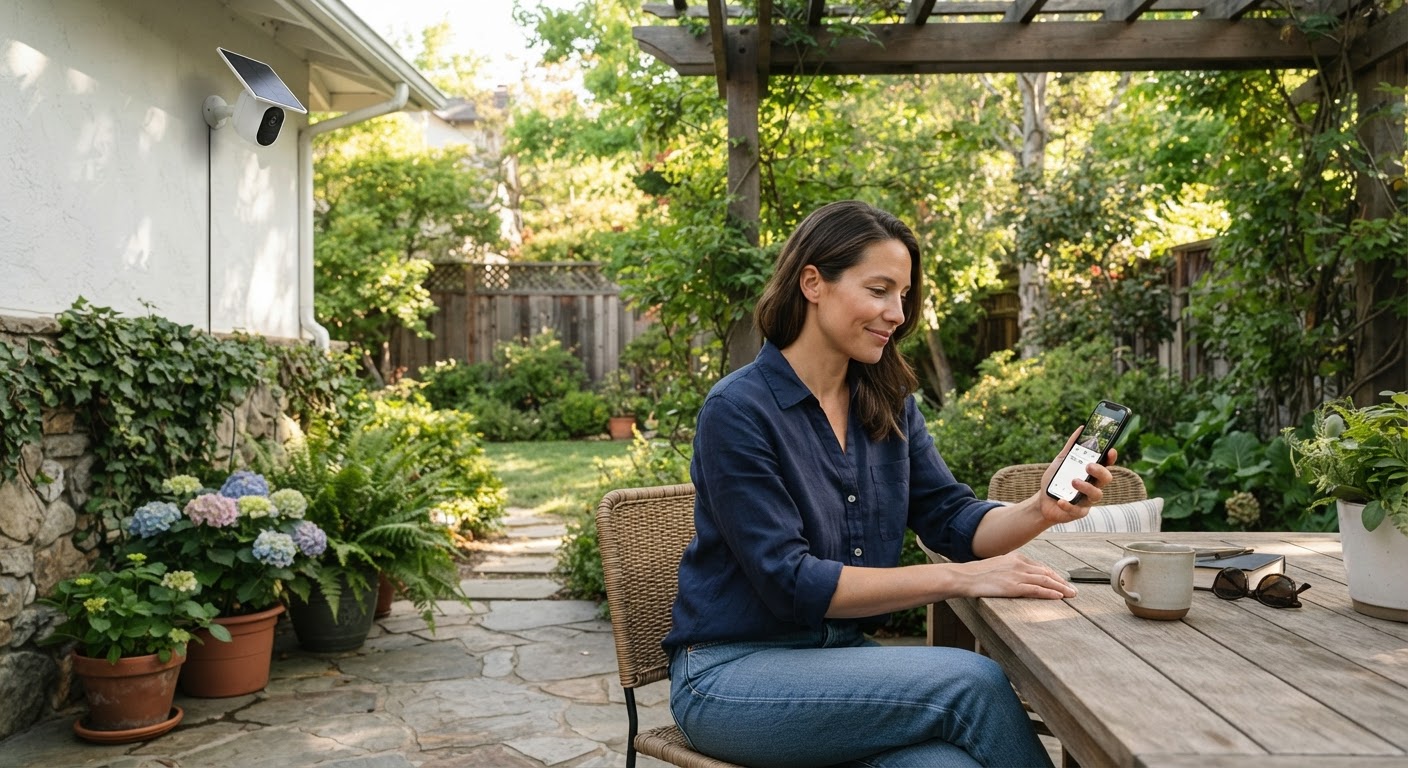
The integrated 3.5W solar panel requires 3-5 hours of direct sunlight per day to maintain continuous charge on its internal 5200 mAh battery. If the weather remains cloudy for extended periods, the high-capacity battery continues powering motion detection and alerts. For complete setup advice, refer to [the main guide]. The figure quoted by any manufacturer assumes average use, and use is the variable that dominates. A camera that records a handful of short events a day draws far less than one watching a busy pavement, because recording, streaming, and infrared illumination are the expensive activities and idle standby is cheap. Two identical cameras on the same wall can have completely different charging needs depending on what passes in front of them.
Photo by Connor Scott McManus on Pexels
Season matters nearly as much. Short winter days combined with a low sun angle can halve what a panel collects compared with midsummer, and that reduction lands in exactly the months when nights are longest and infrared runs hardest.
The practical consequences are worth planning for. Face the panel toward the equator, meaning south in the northern hemisphere. Watch the position across a full day for shade from eaves, trees, and neighbouring buildings, and judge deciduous trees at their summer size. And if the battery is still dropping week on week through winter, the fix is usually to narrow the motion detection zone so the camera stops recording passing traffic, rather than to move the panel.
What initial setup is required before mounting the camera outdoors?
Before mounting hardware outdoors, charge the camera manually using a standard USB cord. The required initial charge time of 8-10 hours ensures the power cell reaches 100% capacity before relying on solar energy trickle charging. The typical battery recharge time via solar power takes 4-8 hours under bright daylight conditions. Do the whole setup indoors before anything goes on a wall. Charging the battery fully from the mains, connecting to wi-fi, updating the firmware, and checking the picture are all far easier at a kitchen table than up a ladder, and a camera that ships partly charged will otherwise spend its first week trying to catch up.
Test the wi-fi signal at the exact mounting position before drilling, using a phone held where the camera will sit. Weak signal is the most common cause of dropped clips and slow live view, and exterior walls, foil-backed insulation, and metal cladding all attenuate it more than people expect. If the signal is marginal, deal with it before mounting rather than after.
While the camera is still indoors, set the time zone, name it, and configure recipients for alerts. And note the credentials somewhere sensible: changing a password on a camera already mounted three metres up is considerably less pleasant than doing it at the table.
How far can the night vision see in total darkness?
The device includes active color night vision that illuminates targets clearly up to a night vision range of 33 feet. Combined with a camera pan angle of 355 degrees operated via the Tuya Smart app, you can easily inspect dark outdoor corners. Stated infrared ranges are measured in ideal conditions, which means a clear night, a reflective subject, and nothing in between. Real range is usually shorter, and several ordinary things reduce it.
Rain and fog scatter infrared light, so a camera that resolves a face at fifteen metres on a dry night may manage half that in drizzle. Dark clothing absorbs infrared and reflects little back, so a person in a black coat is visible at a shorter distance than one in light colours. And rain or spider webs on the lens scatter the camera's own illumination straight back into it, which produces the washed-out white frames that are the most common night-vision complaint of all.
That last point is worth knowing because spiders are genuinely attracted to the warmth and the insects the infrared draws. Wiping the lens and the housing every few weeks does more for night image quality than any setting in the app.
Colour night vision, where available, works differently: it needs some ambient light, usually from a street lamp or a security light, and falls back to infrared in true darkness.
What storage options are available for recorded security video?
The system supports both local physical media and offsite cloud backups. You can install an onboard card with a max MicroSD card capacity of 128 GB. Alternatively, you can activate a cloud storage trial of 30 days to store video clips securely online.
Read the full guide: Complete Guide to Outdoor Solar Security Cameras: Installation, Features, and Setup
There are three broad approaches and each has a failure mode worth knowing before choosing.
A memory card in the camera is cheap, involves no subscription, and keeps recording if the internet drops. Its weakness is obvious: if someone takes the camera, they take the footage, which matters precisely in the scenario the camera exists for. Cards also wear out from continuous rewriting, so a card that has been in service a couple of years is a plausible suspect when clips start failing.
Cloud storage survives theft of the camera and is accessible from anywhere, at the cost of an ongoing subscription and a dependency on the internet connection being up when an event happens.
A local recorder on the property splits the difference, keeping footage off the camera without a subscription, though it needs somewhere to live and its own power.
The pragmatic answer for most homes is both a card and cloud storage, so that theft is covered by one and an internet outage by the other. If cost rules out cloud, a card is still much better than nothing.